Wednesday, January 16, 2013

Pay Attention to Me!

I went shopping today. Actual, physical shopping that didn't involve a mouse and clicking. The entire contents of my underwear drawer have seen better days, and I wanted to buy a few new pairs of panties.

Two facts: 1) I love.love.love Nordstrom. It's truly my favorite store in the whole world. 2) I hate.hate.hate Victoria's Secret, but I like their Supersoft Hiphugger panty. It fits me well and doesn't give me VPL.

In Beachwood Place today, after splurging on a sale Eileen Fisher sweater and T-shirt in Nordstrom ( with excellent assistance from a very nice middle-aged sales associate), I girded my loins (so to speak) and walked into Victoria's Secret. And none of the sales associates would pay attention to me. No one acknowledged my entrance into the store. After I walked around for a few minutes, one young woman asked if she could help me, then pointed me in the opposite direction of the panties I wanted. When I finally found them on my own, no one was around to help me find my size. After I found and selected five pair, I decided I wanted a pair of lounging pajamas to take to California next month. Again, no one offered to help me find what I wanted. After a few minutes, the first girl noticed me. She didn't really try to help me find what I wanted, but spoke in her earpiece to another associate to ask where in the store the pajama room was. The person she spoke to stuck her head around the corner and saw me coming. When I reached the pajama room, she did not acknowledge me nor ask if she could help me even find my size! I couldn't! I took my handful of panties and headed to the register, where I saw only one clerk and five customers in front of me. I walked back to the panty display, tossed the panties on the counter, and walked out of the store.

After a few minutes in Pottery Barn where several clerks acknowledged me and one helped me buy a set of sheets on sale, I headed back to my beloved Nordstrom. Surely the sales associates in the lingerie department would help me find some good-fitting, reasonably priced panties.

Nope. I walked into the department and started searching the racks. Two associates were busily helping other customers. (Good – shows promise.) One young associate was standing at the register, glancing around the department, not making a move from her safe space. I was very visibly lost in a sea of nylon and needing help, but none was offered. After trying to get anyone's attention, I walked out of the department.

Here's my bottom line: If you can't show me a smidgen of good customer service, my credit card is going to stay in my pocket. I'll gladly wait a few minutes if you just say, "I'll be right with you." But I am not going to beg you to take my money.

There are plenty of people in our geographic area who are out of work and would love to have your job. If you don't know the meaning of customer service, please leave and make room for someone who does.

Sunday, January 13, 2013

One Ouch After Another

After visiting my orthopedic surgeon again on January 9, I'm in the brace for three more weeks. During this period, I am to take the brace off three times a day, apply a warm compress to my wrist for a short time, and then attempt to stretch the wrist backwards and forwards. There is but one word for this activity: Ouch!

There is one more newly allowed activity for this time period: Showering! Yesterday I took my first full-body shower in six weeks. It had to be short, rather than long and lingering, as the incision is not yet completely healed. And how strange my arm felt! I attempt every movement with great trepidation. How much pain will be self-inflicted by picking up that washcloth, trimming those toenails, grabbing the end of that towel to dry my back?

But despite the pain–or threat thereof–there is a sense of freedom to having my forearm unsheathed after six weeks of confinement. I allow myself to fantasize that I will be able to do everything exactly as I did before the fall.

And then reality returns. It's going to be a long and painful road back to the operatic accompaniments I was playing all last year. My next gigs are scheduled for the week of March 11. When I am exercising my wrist and feel the pain, I think it will take much longer than one month for me to be able to play again, to be able to earn income again.

And so I repeat my mantra: "It could have been worse."

<Humorous Anecdote On>
I attended the first Cleveland Orchestra Chorus rehearsal of the new year last Monday night. Our director saw me enter the building and came over to greet me. "How did you break your wrist," he asked. "I heard you fell off the piano bench."

That, My Friends, would have been worse!
<Humorous Anecdote Off>

Sunday, December 30, 2012

Day by Boring Day

A month ago today I fell. My first thought as I landed on the Stambaugh Auditorium backstage floor was that, hopefully, my wrist/arm/hand was just bruised and I would get myself off the floor and walk to the stage to start the Barber of Seville overture for our 45-minute presentation for the local elementary, middle, and high school children. I had spent the previous two months mastering this very difficult piano transcription. As I lay crumpled on the floor, more than 400 kids were finding their seats.

When I tried to lift my arm off the floor, I looked in horror as my left hand just dangled from the wrist. I knew instantly that I was in big trouble.

My earlier post about the accident gives all the details of that first day.

My fall occurred on Friday, Nov. 30. On Wednesday, Dec. 5 (my older son's birthday), I was Dr. J. J. Stefancin's first appointment of the day.

The nurse showed me the x-ray sent over by Northside Hospital ER. (See photo above) She pointed to the right side of the radius, where the break occurred, and I could see the bulge of pulverized bone. She told me Dr. Stefancin would have to manually compress the bone back into place before casting my wrist. She assured me he would deaden my wrist before applying this pressure. Then I explained to her that I had started playing piano at age 3½ and wanted to be able to continue when the cast was off. She quickly excused herself and I waited for the doctor to appear. (I learned later that she had gone to alert the doctor to my musical abilities. He would quickly determine that compression and casting would not be my answer!)

In a few minutes the nurse returned with the doctor and the intern. Dr. Stefancin looked long and hard at the x-ray, asked me a few questions, then said I would need surgery. He used his pen as a straight line to illustrate what the wrist joint should look like as compared to what my fall had caused mine to look like. Because of how the bone had disintegrated at the break point, a plate would have to be attached to the bone to give me normal function again. His staff quickly got on the phone and scheduled me into the Surgical Hospital at Southwoods. The scheduler snuck one more appointment into Friday afternoon and I was set to go.

I would get a plate similar to the picture to the right. The four screws at the top secure it at the wrist, then several screws down the shank attach it to the radius. Now all that was left for me to do was to attempt to stay calm until Friday, two days away.

The Jazzman arranged to have the day off to take me to the hospital and keep me from freaking out. To say I was impressed with this facility and every member of the staff with whom I interacted is a gross understatement.

The intake nurse, a compassionate man named David, was excellent at calming me. He shared stories with me about his teenaged son who plays trumpet, piano and guitar. Before inserting the IV needle into the back of my right hand, he asked my permission, telling me about the patient he once had who was a massage therapist and begged for the needle to go anywhere but in her hands. The anesthesiologist, Dr. Gemma, came in and, learning I sing with the Cleveland Orchestra Chorus, promised not to put the breathing tube down past my vocal chords. Further, given the risks of nerve damage in an "arm block" or "nerve block" and my desire to have the same abilities I had before my fall, he agreed that general anesthesia was the best solution. Dr. Stefancin came in briefly to reassure me that he had my best interests at heart. And in a few minutes I was being wheeled into surgery. The last thing I saw before sliding into my drug-induced sleep was our dear friend Diane, who is a surgical nurse at Southwoods and had arranged to be assigned to my case. Seeing her face gave me utter peace of mind.

A couple of hours later I was awakened from a very involved dream to see that I was the only patient remaining in recovery. I was freezing and shaking. The nurse brought me a magical blanket into which hot air was circulating—I want one of those! To get over the shakes, the nurses kept reminding me to take deep breaths from the oxygen tube in my nose. And an hour later we were leaving the hospital.

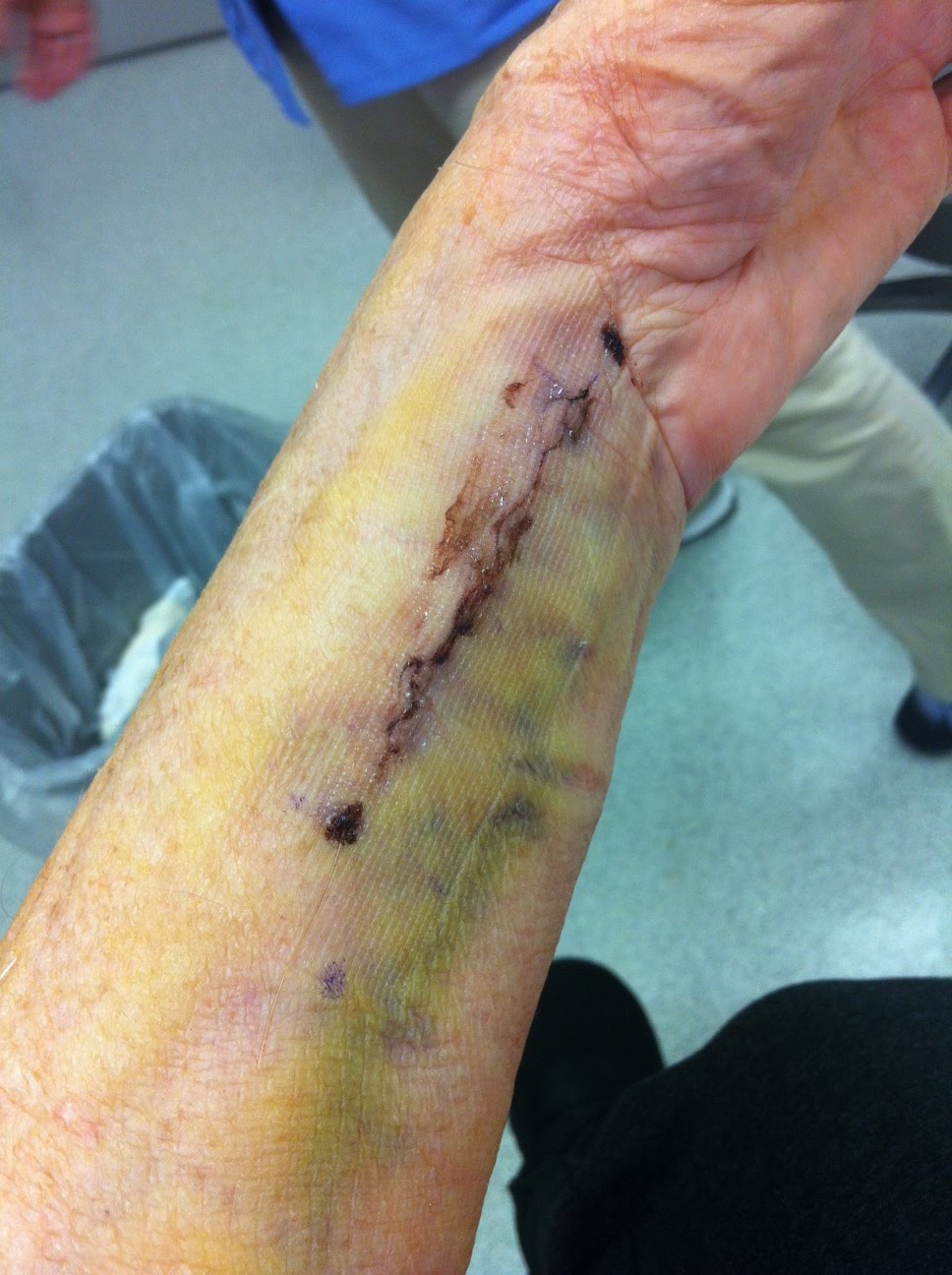
Lots of Vicodin accompanied my next several days. Ten days later, on Dec. 19, I went to Dr. Stefancin's office and saw this lovely and colorful arm.

And now I just wait. I'm in a brace. I alternate between pain, annoyance, and fear. Everyone who has been through a similar injury tells me that—after the pain and toil of physical therapy—I'll be playing my daddy's favorite "Alley Cat" again. And all our friends call and text and email and contact me on Facebook to let me know of their concern.

And my mantra is, "It could have been so much worse!"

All in all, I'm pretty lucky.

Sunday, December 02, 2012

Crash! Boom! Ouch! Damn!!!

In a story of "Timing is everything," Friday was a very bad day.

NOTE: This post is typed entirely with my right hand. You can see where this is going, can't you?

One of my jobs is accompanist (collaborative keyboard artist) for Opera Western Reserve's (OWR) Young Artists Program. Along with two-to-four opera singers who are either finishing college or just beginning their musical careers, I go into local elementary, middle, and high schools to present a "Fun With Opera" educational program.

<PROLOGUE>

We give a little history of the genre and teach the kids various elements—voice parts and ranges, languages used, what all goes into staging an opera (singers, orchestra, conductor, set designer, costume designer and seamstresses, lighting designer, etc.). We try to make it as interactive as possible. Each of the artists sings two aria snippets, and the students choose their favorite.

At the end of the program, the artists perform a brief "opera" they've "composed" with the students' input. (We're at a bus stop. Who are we and why are we here? How do we feel about being here?) The suggestions from the kids are frequently hilarious. And sometimes sobering. For example, you're a mom going to school to pick up your sick kid. Or you're out of work and you're on your way to a job interview. Or you're on your way to work in a doctor's office and you hate your job. I hear months from teachers that the kids love our visits and fondly remember these improvised operas.

The other function of the Young Artists Program is to stage an abbreviated version of the opera that will be presented by OWR. We begin several months before the scheduled performance date. I sit down with the production director, David Vosburgh, who determines which arias and recitatives are required to tell the story, and what is merely fluff or repetition the can be omitted. The score is condensed to about 40 minutes. A director is named, roles are assigned, and singers begin learning and memorizing their music. (It's important to note that many of these singers also have different roles in the main stage performance&emdash;double the work! The school performance takes place at 10:00 a.m. on the same day that the full performance will occur at 7:30 p.m.

<THE STORY>

Over two months ago, I received the music for this performance. Simultaneously, I was learning the accompaniment and rehearsing for a cabaret evening of obscure Broadway tunes to be performed by a Cleveland Orchestra Chorus (COC) colleague of mine, and learning the alto part of all the COC Christmas music. The past two months have been absolutely overwhelming for me, and when my alarm rang at 6:00 on Friday morning, I turned it off with a distinct sense of relief. In six hours I would be done with "The Barber of Seville" and—after a celebratory lunch—could just focus on holiday music.

The cast met backstage at Stambaugh Auditorium at 7:45. We quickly ran the finale, then at 8:15 began a full run-thru, noting the points where we'd have to pay special attention during performance. At 9:25 we were told there were hundreds of kids outside who wanted to be let in. We cleared the stage and reassembled backstage to finish talking through any trouble spots, check hair and makeup, and prepare to go on and wow the kids.

I had only been backstage in this hall once before, so had to ask one of the girls directions to the Ladies Room. I walked in, answered Nature's call, washed my hands, and opened the door to step out into the hallway. I didn't remember that I had successfully negotiated a very tall step to get into the restroom, so stepped out as if the hall floor was at the same level as the restroom. I quickly realized there was a problem.

I started doing the "Please Help Me, I'm Fallin'" two-step. I thought I had recovered my balance, but then felt myself falling toward the wall and put out my left hand to catch myself. The next thing I knew I was on the floor. My first thought was a hope my left hand/arm was only bruised so I could play the show. Then I reached over with my right hand and lifted my left arm, only to watch my hand droop. Trouble. I was in real trouble!

I called out to the cast who had no idea what had happened. Somehow they helped me get to my feet. They radioed someone in front of house to come help me. Someone retrieved my phone. Fortunately for me, my daughter-in-law was home a half-mile away and, at my phone call, hopped in the van to get me and take me to Northside hospital a mile away.

Northside ER personnel were wonderful to me, getting me into a room quickly and getting me pain meds. (I had no idea a broken bone could hurt. OMG, the pain!) They even put me right back into the same room where I was on Tuesday for my bronchitis diagnosis. How thoughtful.

Two hours later I was diagnosed and splinted and had instructions for seeing a doctor on Monday. The PA, who had also treated me on Tuesday,

Tuesday, November 20, 2012

In One Door and Out Another

I watched out the kitchen window this afternoon as my neighbor filled her bird feeder. She's retiring in about four weeks, and each time we chat I witness the glee in her eyes.

She has dotted all her Is and crossed her Ts. She has prepared for this retirement. She has acted wisely at every turn. She's ready, willing, and able.

I, on the other hand, have fallen into retirement. My retirement could also be called underemployment, or even unemployment. I made no plans. I had no scheme. Preparation - what's that?!

But then, if I look back to the beginning of my so-called career, I had no plan or scheme there, either. I bounced from college to college and job to job. I got married at age 21 (!) to someone I didn't much like because he said God wanted him to marry me, and because I just didn't know what else to do. Bad [un]plan.

I worked a while as a secretary, then stayed home with my babies, taking occasional part-time piano jobs and keeping books for my daddy's medical practice.

There was no roadmap. There was no order to my life.

When I divorced, I began hoeing three rows at a time, as my rural Tennessee-born ex-mother-in-law would have said. I worked full-time as a programmer at IBM, went to school at night, and frequently played piano in local hotel lounges on weekends. Sometimes I wonder if I can't find a job now because there's a quota on the number of jobs one can hold during life, and I passed that number years ago.

At the end of my career, I left a good salary in a hostile work environment to work on a freelance basis for my son. Then the work I was doing for him decreased, and kept decreasing. In a manner as disordered as that in which I entered the workforce, I was slowly leaving the workforce. Month by month, hour by hour.

Now that I've tasted some form of retirement, I'm not very motivated to leave it by finding full-time employment. The luxury of not setting an alarm, of not considering what office-acceptable attire I'm going to don each day, of not worrying about ticking off some colleague .... It's just that—it's pure luxury.

So I don't get to have a retirement party. So I don't get an engraved Rolex or a pen set for my desk. I can buy my own damned watch. I can throw my own damned party.

We have a friend who retired several years ago. She liked her retirement party so much that she invites all her friends to meet her for dinner every Tuesday night. She calls it "Retirement Dinner."

Monday, November 05, 2012

What I *Did* Like!

After writing yesterday's blog post, I realized it could be perceived as negative. At various times throughout my life, I've been accused of speaking negatively when I thought I was just laying out the facts. So, to let you know that Saturday night was a positive—not negative—experience, here's my take on what I loved.

Matt introduced me to a lot of new repertoire, and some new takes on old repertoire. Now, you already know (from various accounts of weekends PianoLady and I have shared in NYC attending Broadway shows) that I'm a big Broadway fan, and particularly musical theatre. So to learn new tunes—what a treat!

Several years ago PianoLady and I saw "The Light in the Piazza," with music and lyrics by Adam Guettel. Falling in love with the music, I started googling and learned that Adam Guettel is an alum of Interlochen Center for the Arts (as is my younger son) and that his grandfather was Richard Rodgers. When Matt handed me the music for "How Glory Goes" and said it was from the musical "Floyd Collins," I didn't realize that Adam Guettel was the composer and lyricist. Unlike some of the music I've been learning lately where the harmonies are complex but make no sense, the voicing Guettel used on Glory is so well thought out, so musical ... I fell more in love with the work each time I sat to rehearse. As Matt performed it, I felt he loved the piece as much as I did.

Another new tune to me was "Tell My Father" from the 1999 musical "The Civil War." The composer is Frank Wildhorn. I was familiar with neither the musical nor the piece. Matt performed it with a slightly country music feel, very balladic, and I loved it.

Another Wildhorn tune that was new to me was "This is the Moment," from "Jekyll and Hyde." This tune, this arrangement, allowed me to deviate from the printed music and just be myself on the keys. Matt chose a truly beautiful piece with which to end his evening of music.

And finishing on the theme of "What I Loved" is "Everybody Says Don't" from "Anyone Can Whistle," composed by Stephen Sondheim. I've known the tune for a long time, but Matt made it even more appealing to me by pairing it with "Don't Rain on My Parade," which is from my all-time favorite movie ever—"Funny Girl."

As a preteen and teen, I would come home from school and sit in the afternoons working picture puzzles on the coffee table in the living room, playing recordings from musical theatre that my daddy had gotten for me. I wore out the groove in so many records. Oklahoma, Funny Girl, the Reader's Digest collection of Gilbert & Sullivan. I sang at the top of my lungs. I finally saw the movie "Funny Girl" when I was in college. Love.love.love that music.

Matt's brilliant melding of those two songs delighted me. When we rehearsed and performed the two, I couldn't stop smiling. What a blast!!

So, you see, despite dropping some notes on the floor, I pushed plenty of notes into the piano keyboard. And I had a truly wonderful time.

I'm not all negative!!

Sunday, November 04, 2012

Black Dots

Last night I accompanied a COC friend, Matt Rizer, in a performance of mostly obscure Broadway tunes. We had been preparing for about two months to give this recital.

Some of the pieces he chose were just a joy to play—they seemed to roll off my fingers through the keys to present utter beauty. Some were far more challenging, either in just not resonating within me, or in having just too many black dots on the page.

My favorite type of accompaniment is for a singer who grabs a tune and flies with it, secure in herself and knowing that—wherever she goes and whatever she does with the tune—I'm right there underneath her, making her flights of fantasy possible. (I've had great experiences that fit this definition with my dear friends LaVerne Davis Lawrence in Tucson and Judy Sokol, an ex-Washingtonian now living in Sarasota.)

Last night's repertoire, in contrast, had a number of song versions that, due to their complex arrangements, were designed to be played note for note.

Think for a moment about the nature of accompanying. The pianist is focusing on the notes printed on the pages, but also on moving those notes to the keys without error; on never overpowering the soloist (or performers); on splitting sight between the keys, the music, and the soloist; on dealing with lighting (is there enough light to see, are there lights flickering that disrupt my vision); on tempo and volume and being on the right page; and on staying focused despite a hundred variables in the environment.

Two pieces were problematic for me last night. The first was "Putting It Together," from "Sunday in the Park With George," which opened the second half. The lyrics involve the million facets of bringing a piece of art—whether song or sculpture—from idea to fruition, to being seen or heard by the public. It's a "patter" song: lots of words, lots of repetition. There is not much variation from verse to verse, i.e., it's easy for either the singer or the accompanist to get lost. And it moves lickety-split. The speed of light. No room for error.

We rehearsed and rehearsed this piece. [At Matt's brilliant suggestion,] I copied and cut-and-pasted the music so there would be no page back-turns for repeats. It was just 20-or-so pages, one after the other. We had agreed that if either of us got lost, we'd just pick it up and keep going.

And I got lost. Even with a page-turner who had his eyes glued to the music to keep me on track, I got lost. And we just stopped. Matt looked over at me and I just laughed out loud at the impossibility of it all. In front of the audience, I just laughed. Really, what else could I do? He turned back to his "teleprompter," grabbed a lyric, and took off again. Then on the last page, we somehow got separated again. A phrase that was to be duplicated in the voice and the accompaniment somehow got played by me and then sung a Capella by him. Oops. But we started and finished together. Does that count?

[When I laughed (really, how unprofessional can one pianist be?!), all I could think of was the fact that Matt was recording the performance and I had just seriously messed up the recording.]

The second problem child was "You'll Never Walk Alone." Matt had chosen the Streisand version, which includes a number of key changes throughout. Umm, some of these new keys have no reference point to the previous key. I've been playing this song in various versions since I was about 10 years old. I would have loved to have just taken off and done my own underlayment, but with this awkward arrangement (which on the recording has a number of back-up singers and an entire orchestra) I needed to stick to the ink on the page. I flubbed a few notes on each of the key changes, but Matt kept his pitch, kept going, and we finished together. Bravo to him!

Now here's the question for the ages: Let's say I played 10,000 notes perfectly, 1,000 notes acceptably, and 100 notes poorly or not at all. Why, for days afterward, will I only remember the 100 notes?!

Matt had already chosen most of his repertoire before asking me to accompany him (without ever having heard me play, I might add — without knowing I have a gift for accompaniment). Now that he knows what I can do, maybe next time he'll be able to choose tunes he loves rather than arrangements he loves, and enable us to just create something wonderful between us.

[I am not saying there was not a whole lotta wonderful going on last night. There absolutely was. But I felt somewhat constrained by all that ink. I would rather have followed the neurons than the dots.]

The grace of last night was that the room was filled with friends. We were on the floor of a lovely church hall, rather than on a stage. I could laugh out loud when I messed up, partially because over half of the audience members were also musicians and had dropped their own black dots from the music to the floor at various times.

We set a goal. We worked our vocal chords and our fingers and our brains. We achieved our goal—quite beautifully, if I may say so myself.

We started together. We ended together.

And my musical life goes on. In five hours, I've got to be back on stage again, performing a whole 'nother set of black dots for five talented young opera singers.

Here's hoping I won't (very unprofessionally) laugh out loud. Or need to.