Tuesday, November 20, 2012

In One Door and Out Another

I watched out the kitchen window this afternoon as my neighbor filled her bird feeder. She's retiring in about four weeks, and each time we chat I witness the glee in her eyes.

She has dotted all her Is and crossed her Ts. She has prepared for this retirement. She has acted wisely at every turn. She's ready, willing, and able.

I, on the other hand, have fallen into retirement. My retirement could also be called underemployment, or even unemployment. I made no plans. I had no scheme. Preparation - what's that?!

But then, if I look back to the beginning of my so-called career, I had no plan or scheme there, either. I bounced from college to college and job to job. I got married at age 21 (!) to someone I didn't much like because he said God wanted him to marry me, and because I just didn't know what else to do. Bad [un]plan.

I worked a while as a secretary, then stayed home with my babies, taking occasional part-time piano jobs and keeping books for my daddy's medical practice.

There was no roadmap. There was no order to my life.

When I divorced, I began hoeing three rows at a time, as my rural Tennessee-born ex-mother-in-law would have said. I worked full-time as a programmer at IBM, went to school at night, and frequently played piano in local hotel lounges on weekends. Sometimes I wonder if I can't find a job now because there's a quota on the number of jobs one can hold during life, and I passed that number years ago.

At the end of my career, I left a good salary in a hostile work environment to work on a freelance basis for my son. Then the work I was doing for him decreased, and kept decreasing. In a manner as disordered as that in which I entered the workforce, I was slowly leaving the workforce. Month by month, hour by hour.

Now that I've tasted some form of retirement, I'm not very motivated to leave it by finding full-time employment. The luxury of not setting an alarm, of not considering what office-acceptable attire I'm going to don each day, of not worrying about ticking off some colleague .... It's just that—it's pure luxury.

So I don't get to have a retirement party. So I don't get an engraved Rolex or a pen set for my desk. I can buy my own damned watch. I can throw my own damned party.

We have a friend who retired several years ago. She liked her retirement party so much that she invites all her friends to meet her for dinner every Tuesday night. She calls it "Retirement Dinner."

Monday, November 05, 2012

What I *Did* Like!

After writing yesterday's blog post, I realized it could be perceived as negative. At various times throughout my life, I've been accused of speaking negatively when I thought I was just laying out the facts. So, to let you know that Saturday night was a positive—not negative—experience, here's my take on what I loved.

Matt introduced me to a lot of new repertoire, and some new takes on old repertoire. Now, you already know (from various accounts of weekends PianoLady and I have shared in NYC attending Broadway shows) that I'm a big Broadway fan, and particularly musical theatre. So to learn new tunes—what a treat!

Several years ago PianoLady and I saw "The Light in the Piazza," with music and lyrics by Adam Guettel. Falling in love with the music, I started googling and learned that Adam Guettel is an alum of Interlochen Center for the Arts (as is my younger son) and that his grandfather was Richard Rodgers. When Matt handed me the music for "How Glory Goes" and said it was from the musical "Floyd Collins," I didn't realize that Adam Guettel was the composer and lyricist. Unlike some of the music I've been learning lately where the harmonies are complex but make no sense, the voicing Guettel used on Glory is so well thought out, so musical ... I fell more in love with the work each time I sat to rehearse. As Matt performed it, I felt he loved the piece as much as I did.

Another new tune to me was "Tell My Father" from the 1999 musical "The Civil War." The composer is Frank Wildhorn. I was familiar with neither the musical nor the piece. Matt performed it with a slightly country music feel, very balladic, and I loved it.

Another Wildhorn tune that was new to me was "This is the Moment," from "Jekyll and Hyde." This tune, this arrangement, allowed me to deviate from the printed music and just be myself on the keys. Matt chose a truly beautiful piece with which to end his evening of music.

And finishing on the theme of "What I Loved" is "Everybody Says Don't" from "Anyone Can Whistle," composed by Stephen Sondheim. I've known the tune for a long time, but Matt made it even more appealing to me by pairing it with "Don't Rain on My Parade," which is from my all-time favorite movie ever—"Funny Girl."

As a preteen and teen, I would come home from school and sit in the afternoons working picture puzzles on the coffee table in the living room, playing recordings from musical theatre that my daddy had gotten for me. I wore out the groove in so many records. Oklahoma, Funny Girl, the Reader's Digest collection of Gilbert & Sullivan. I sang at the top of my lungs. I finally saw the movie "Funny Girl" when I was in college. Love.love.love that music.

Matt's brilliant melding of those two songs delighted me. When we rehearsed and performed the two, I couldn't stop smiling. What a blast!!

So, you see, despite dropping some notes on the floor, I pushed plenty of notes into the piano keyboard. And I had a truly wonderful time.

I'm not all negative!!

Sunday, November 04, 2012

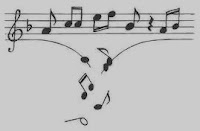
Black Dots

Last night I accompanied a COC friend, Matt Rizer, in a performance of mostly obscure Broadway tunes. We had been preparing for about two months to give this recital.

Some of the pieces he chose were just a joy to play—they seemed to roll off my fingers through the keys to present utter beauty. Some were far more challenging, either in just not resonating within me, or in having just too many black dots on the page.

My favorite type of accompaniment is for a singer who grabs a tune and flies with it, secure in herself and knowing that—wherever she goes and whatever she does with the tune—I'm right there underneath her, making her flights of fantasy possible. (I've had great experiences that fit this definition with my dear friends LaVerne Davis Lawrence in Tucson and Judy Sokol, an ex-Washingtonian now living in Sarasota.)

Last night's repertoire, in contrast, had a number of song versions that, due to their complex arrangements, were designed to be played note for note.

Think for a moment about the nature of accompanying. The pianist is focusing on the notes printed on the pages, but also on moving those notes to the keys without error; on never overpowering the soloist (or performers); on splitting sight between the keys, the music, and the soloist; on dealing with lighting (is there enough light to see, are there lights flickering that disrupt my vision); on tempo and volume and being on the right page; and on staying focused despite a hundred variables in the environment.

Two pieces were problematic for me last night. The first was "Putting It Together," from "Sunday in the Park With George," which opened the second half. The lyrics involve the million facets of bringing a piece of art—whether song or sculpture—from idea to fruition, to being seen or heard by the public. It's a "patter" song: lots of words, lots of repetition. There is not much variation from verse to verse, i.e., it's easy for either the singer or the accompanist to get lost. And it moves lickety-split. The speed of light. No room for error.

We rehearsed and rehearsed this piece. [At Matt's brilliant suggestion,] I copied and cut-and-pasted the music so there would be no page back-turns for repeats. It was just 20-or-so pages, one after the other. We had agreed that if either of us got lost, we'd just pick it up and keep going.

And I got lost. Even with a page-turner who had his eyes glued to the music to keep me on track, I got lost. And we just stopped. Matt looked over at me and I just laughed out loud at the impossibility of it all. In front of the audience, I just laughed. Really, what else could I do? He turned back to his "teleprompter," grabbed a lyric, and took off again. Then on the last page, we somehow got separated again. A phrase that was to be duplicated in the voice and the accompaniment somehow got played by me and then sung a Capella by him. Oops. But we started and finished together. Does that count?

[When I laughed (really, how unprofessional can one pianist be?!), all I could think of was the fact that Matt was recording the performance and I had just seriously messed up the recording.]

The second problem child was "You'll Never Walk Alone." Matt had chosen the Streisand version, which includes a number of key changes throughout. Umm, some of these new keys have no reference point to the previous key. I've been playing this song in various versions since I was about 10 years old. I would have loved to have just taken off and done my own underlayment, but with this awkward arrangement (which on the recording has a number of back-up singers and an entire orchestra) I needed to stick to the ink on the page. I flubbed a few notes on each of the key changes, but Matt kept his pitch, kept going, and we finished together. Bravo to him!

Now here's the question for the ages: Let's say I played 10,000 notes perfectly, 1,000 notes acceptably, and 100 notes poorly or not at all. Why, for days afterward, will I only remember the 100 notes?!

Matt had already chosen most of his repertoire before asking me to accompany him (without ever having heard me play, I might add — without knowing I have a gift for accompaniment). Now that he knows what I can do, maybe next time he'll be able to choose tunes he loves rather than arrangements he loves, and enable us to just create something wonderful between us.

[I am not saying there was not a whole lotta wonderful going on last night. There absolutely was. But I felt somewhat constrained by all that ink. I would rather have followed the neurons than the dots.]

The grace of last night was that the room was filled with friends. We were on the floor of a lovely church hall, rather than on a stage. I could laugh out loud when I messed up, partially because over half of the audience members were also musicians and had dropped their own black dots from the music to the floor at various times.

We set a goal. We worked our vocal chords and our fingers and our brains. We achieved our goal—quite beautifully, if I may say so myself.

We started together. We ended together.

And my musical life goes on. In five hours, I've got to be back on stage again, performing a whole 'nother set of black dots for five talented young opera singers.

Here's hoping I won't (very unprofessionally) laugh out loud. Or need to.

Thursday, October 18, 2012

The Joy of Making Music

I posted this on Facebook today, and want to share it with those of you who read my words here but are not on Facebook.

I'm exhausted from the stress of concert week, but I'm incredibly lucky.
If you wonder what 120 of my musical colleagues and I do in the evenings during Cleveland Orchestra concert weeks, we drive many miles and many minutes every night of the week to Severance Hall in Cleveland's University Circle, warm up our voices, then process and sit on stage behind the Cleveland Orchestra while we wait patiently for our turn to make music. For me it's 140 miles and over 3 hours total, just for the commute. We are at the hall from 2-4 hours, depending on the concert. There are those who drive further and longer than I. We receive no salary nor reimbursement for our expenses. The IRS lets us deduct 14 cents per mile for our auto expense. We spend over $200 a week for gas. It's a lot of money and a lot of time away from our families. Why do we do it? For the incredible experience of making music with the Cleveland Orchestra and with each other. We are truly lucky.

Monday, October 08, 2012

Work to Live; Live to Travel

I have a really good guy with whom every breath of every day is fun. I just found this photo that one of our traveling friends took of us on the Italian Riviera in May of this year. And now we're talking about the next big vacation.

How does a river cruise in 2013 through Paris and other European capitals sound?

Sounds pretty darned good to me.

Proving Oneself

The normal musician chooses a place for his or her career, puts down roots, makes contacts, and gets jobs. After the first job, if she is good, the future jobs just follow along like baby geese.

The abnormal musician (waving hand in air) follows the men in her life around the country. Each time she gets to a new location, she starts all over again to establish her credibility as a first-rate accompanist and lounge pianist. She must go out to suitable venues, find pianists whose work she identifies with, introduce herself and offer to sub for them when they want a night off, and be willing to drop everything at a moment's notice when the regular pianist is sick. She's got to be willing to work two and three jobs at a time, meet some sleezy characters, and—hopefully—have fun bringing enjoyment to people sitting in bars or theatres.

In Orlando it began with someone in the entertainment division at Walt Disney World calling my university music department and asking for the name of the best pianist they had. They were given my name, and for seven years I served as Staff Accompanist.

First Husband and I moved to Sarasota and I served as church pianist, meeting several people who knew people in the entertainment community. I played for local musical theatre productions and for voice lessons at the community college. Then we moved to Ft. Worth and I started playing for ballet classes at TCU. When my husband and I divorced, I started playing at Tavern of the Fierce Sparrow at the Hilton on Mockingbird in Dallas, and experienced being handed a room key for the first time!

Second Husband (followed by 2nd divorce and Third Husband and ...) happened along and I moved to the D.C. suburbs. Over the next 16 years I played in hotel lounges and at private parties. When Nordstrom came to town, I introduced myself to the piano manager at the Pentagon City store and began nine enjoyable years of "making beautiful music to shop by."

With the move to Tucson following my husband's death and my meeting the next Significant Other, I started all over again. I started volunteering to play for an Alzheimer's Support Group at St. Phillip's in the Hills. Slowly I met more and more people. I began working in administration for the symphony and met people there who had contacts. Talking to a woman who was reading sheet music in my Starbucks led to my accompanying the CYT organization and meeting some wonderful and talented people. From that I had the honor of working with the megatalented Robert Encila on a showcase at St. Francis in the Foothills. And then I moved again.

With this move, I've had the hardest time re-establishing myself. I met people through Easy Street Productions when I helped my son with some projects there. I introduced myself to a well-known and well-connected pianist, who threw some gigs my way. My name was given to the production director of Opera Western Reserve and I began accompanying their Young Artists program. And then somehow a man in the chorus heard me say something about being an accompanist and asked—without ever hearing me play—if I'd accompany him on an upcoming cabaret night. What a leap of faith!

We had our first rehearsal Saturday afternoon for a show that will take place on November 3 at First Baptist Church on Fairmount in Cleveland.

I feel like I need to keep thanking him for taking a chance on me. How good it feels to be collaborating again and making lovely music with skilled and talented musicians!

Here's to never having to re-establish myself again!

(The photo? Nordstrom Pentagon City, Christmas season, 1990 or 1991. Each year Nordstrom would have a holiday preview night, with glitz and glamor. Great fun. Beautiful holiday music to shop by!)

Friday, October 05, 2012

The Ins and Outs of Cleaning

Over the past few days I've been trying to declutter and clean my sewing room, yet again. I took DGS to a lampwork beadmaking class last weekend, and now I'm trying to set up a glass and torch station for us in the sewing room. But there's so much stuff in there!

There are fabrics collected over years of travel and oh-isn't-that-pretty-I-could-use-that-someday. There are three sewing machines. There are materials for beading and cross-stitching and knitting and felting and dyeing and ...

You get the idea!

This morning, while devoting another hour to cleaning out that area, I found a card describing a handcrafted pottery bowl I bought in a Sedona gallery about nine years ago. The bowl is sitting on my antique breakfront in the front hall. Why is the descriptive card in my sewing room? Because I don't know what to do with it.

That, my friends, is one of my biggest problems. When I come across something that I don't know what to do with—where to put—I leave it where I found it. Each time I'm cleaning or organizing that room, I find the item again. I pick it up, look at it, wonder what to do with it, and put it down. Pretty soon I don't see it any more.

When the Jazzman first moved in with me, he laughed at the places I put things. A plastic storage box of picture-hanging equipment was on the shelf in the coat closet off the front hall. Why? Because the last time I hung a picture, it was in that hall. And because I know the box is there.

Light bulbs? They're in the upstairs hall, in the small storage space behind the door that leads to the attic. At least they were. The last time I went looking there for a lightbulb, the Jazzman told me they were now in the tool room in the basement. Along with the picture-hanging equipment and all the tools and the step stool. Along with everything an organized handyman would need to fix any problem in a big old early-20th Century house.

Of course. Because he's organized.

Me? I'm just befuddled!

When I try to clean house, I get waylaid by every little this or that which should be put away someplace, if I could only figure out where.

Can you understand why I love my Molly Maids so much? They come every other Friday, and nothing befuddles them. They move through my house like machines, and I'm left with order and fresh smells.

Now that's love!

(The card describing the fabulous handcrafted bowl? It's now in the top drawer of the breakfront on which the bowl rests. Isn't that a step in the right direction?)